Chicago's Mental Health Landscape
When I checked into Montrose Behavioral Health in February 2026, I sought a safe space where I could get help during an acute mental health crisis. I needed intensive, focused, professional attention that would start me on a path to better mental health and recovery. What I actually experienced while at Montrose was very different.
I was fitted with an ankle monitor. I couldn’t see outside because the windows were obscured. I wasn’t given my medications in time and didn’t have any individual therapy sessions (even though the website claims that Montrose provides those services).
Now, I’m on a mission to understand why Montrose (and other mental hospitals like it) is so terrible and the systems in place that allow it to continue failing its patients. For clarity and brevity, I’m specifically focusing on mental hospitals with adult programs. There is a lot to be said about child and adolescent mental health issues– hospitals that serve children in the foster care system are under immense strain and the constant risk of closure – but here I will focus here on the adult experience of mental healthcare, or lack thereof, and why hospitals like Montrose are difficult to hold accountable for their patient care practices.
To better comprehend the dreadful state of these facilities, you have to understand the wider context of mental health care policy in the United States and how it has impacted the Chicago area for the last few decades.
A BIT OF NATIONAL HISTORY - DEINSTITUTIONALIZATION
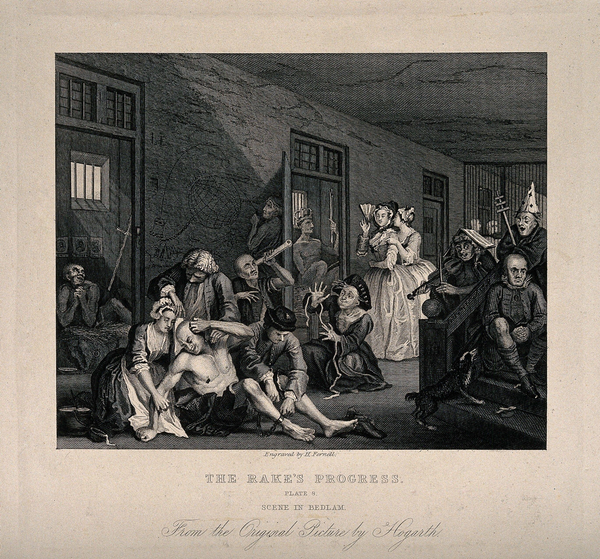
President John F. Kennedy had an older sister, Rosemary, who was born with cognitive and physical disabilities. Her physical and cognitive impairments coincided with emotional and psychological imbalances. Back in the 1920s and 30s, the field of psychiatry and neuroscience had not yet developed treatments for people like Rosemary. By the time Rosemary was 23, her father arranged for her to receive a lobotomy: a procedure that was new at the time, but has since been deemed inhumane and ineffective. Afterwards, Rosemary’s condition deteriorated and she languished for years in a psychiatric hospital. As a witness to his sister’s plight, JFK developed a keen awareness of how poorly the American mental healthcare system served its patients. Psychiatric hospitals were, for the most part, places where the mentally ill were isolated from society in the hopes of preventing them from doing harm to themselves or others.
When JFK became president, his experience witnessing Rosemary’s deterioration at the hands of psychiatric hospitals led him to establish the Community Mental Health Act (CMHA). The Act intended to “deinstitutionalize” large psychiatric facilities to create smaller, community-run mental health facilities with the goal of decreasing “the number of institutionalized individuals” (Erickson). Deinstitutionalization was an extension of the 1960s Civil Rights Movement, which sought equality for all people, including those on the margins of society, like the mentally ill, who were mistreated in prison-like surroundings and had to endure restraints, isolation, and abuse.
The changes in societal views, medical treatments, and funding models were the major forces driving deinstitutionalization. In the mid-twentieth century, psychiatry evolved with the manufacturing of new drugs, like thorazine, that could stabilize mentally ill patients without the use of restraints or isolation. At the time, lawmakers, led by JFK, hoped that a combination of community-led mental health centers and new medical treatments would diminish the need for psychiatric hospitals.
Another major part of the new law – which still impacts us today – involved a revised funding model. Rather than individual states taking financial responsibility for mental health patients, the federal government started to share responsibility with states. And since the federal government decided to step in and help with funding in the form of community hospitals and nursing homes paid for by Medicaid and other federal funds, states no longer had an incentive to spend their money on state-run facilities (Yohanna).
However, community run mental health centers lagged behind in openings and could not keep up with the increased demand from the closure of huge psychiatric hospitals. “Because of construction and long-term funding impediments, states built approximately half of the 1,500 centers outlined in the CMHA (2). The nationwide state mental hospital census decreased by over 90% by the early 2000s (8), from a peak of 558,922 in 1955 (2). Individuals with diagnoses of serious mental illness were scattered across the mental health treatment system, with no single organization accepting longitudinal responsibility to address their basic needs” (Erickson).
The long-standing support system for those with mental illnesses had crumbled in the decades after the 1960s. Increasing numbers of people with mental illnesses found themselves on the street, or in and out of jails, with no alternatives. “An optimistic federal belief in locally sustained community mental health care in part drove deinstitutionalization. The CMHA and its failings teach us that optimism without infrastructure slows the path to success” (Erickson).
What followed in the decades after the CMHA was a slow-moving avalanche of mismanagement at the federal and state level that left gaps in mental health care for millions of Americans, with cuts continuing to this day. This year, Trump admin cut mental health care spending, including
“five critical behavioral health and suicide prevention programs, totaling over $5.94 million and affecting hundreds of people and providers.”
But even before Trump-era funding cuts, for-profit institutions have been stepping in to fill decades-long gaps left by state and federal funding models.
LOCAL CHICAGO MENTAL HEALTH HISTORY
Decades of deinstitutionalization also affected patients at mental hospitals in and around Chicago, with large psychiatric hospitals closing in the 1970s. Peoria mental hospital closed in 1973 followed by Manteno in 1985. Elgin originally shut in 1972 and was demolished in 1993.
The 1990s saw more closures, such as Metro Child and Adolescent Facility in 1997-1999 and Zeller Mental Health Center in 2001-2002. Governor Pat Quinn co-signed the closing of more centers after 2011, with Tinley Park Mental Health Center: Chicago South closing in 2012 and Singer Mental Health Center in Rockford in 2013 (NRI).
In 2012, Chicago Mayor Rahm Emanuel followed in the Governor’s footsteps by shutting down six city-run mental health clinics, continuing the pattern of disinvestment that started in the 1960s.
A BRIEF HISTORY OF MONTROSE BEHAVIORAL HEALTH
While state- and city-run mental health clinics were shutting down around Illinois and the Chicagoland area, for-profit mental hospitals saw opportunities to start businesses in their wake. Lakeshore Hospital (later to be known as Montrose), was one such facility.
Lakeshore Hospital had a track record of abuse and neglect. Owned by Signature Health Services, Lakeshore Hospital was the subject of numerous abuse allegations, and later investigations found patterns of abuse so pernicious that the Illinois Department of Public Health ordered it to be shut down.
After Lakeshore shut down, Signature Health Services sold it to Acadia Healthcare, and it was re-opened and renamed Montrose Behavioral Health in 2021. Since 2021, it hasn’t had the best track record, as evident in these Health Inspection reports.
WHO HOLDS FOR-PROFIT MENTAL HOSPITALS ACCOUNTABLE?
The abuses that occur at for-profit mental hospitals are the result of a for-profit model that bypasses accountability to increase shareholder value.
Accountability starts with rules, and the rules at Montrose are plastered all over the walls: the Patients’ Rights Code of Federal Regulations stipulates that facilities like Montrose are responsible for the overall safety and well-being of its patients, and that patients have the right to contact a Patient Advocate at the hospital in cases of abuse or neglect.
However, on a day-to-day basis, the only people overseeing patients are nurses and BHAs. The city doesn’t do regular inspections, and neither does the state, so Montrose isn’t accountable to city or state standards (except for opening permits, which are approved by the Illinois Health Facilities and Services Review Board).
The primary organization that conducts surveys and inspections, and provides accreditation, is The Joint Commission. Montrose, and other hospitals like it, pays The Joint Commission for accreditation and allows the Commission to visit its facility to conduct surveys. Because this is a business transaction, Montrose knows when the Commission is planning to visit and has time to prepare. Former patients can also submit complaints and grievances online to The Joint Commission.
Because for-profit hospitals like Montrose take federal funds like Medicare and Medicaid, the Centers for Medicare and Medicaid Services conduct regular inspections and investigate deficiencies cited in patient complaints. The Association of Healthcare Journalists (AHCJ) compiles and organizes these reports, and you can view Montrose’s reports here. Heads-up: the reports are bad.
The Office of Inspector General has no purview over Montrose (because I emailed and asked), but patients can file a complaint with the Illinois Department of Public Health.
Patients can also call the phone number listed on Acadia’s site (615 861 6000) to file a complaint, and when you do, you speak to a representative at a third-party vendor called MedX Global, who takes your contact info and your complaint, and emails you a record of your phone call conversation. I called on June 19 2026 to ask why Montrose uses ankle monitors and obscures its windows. I haven’t received a response yet.
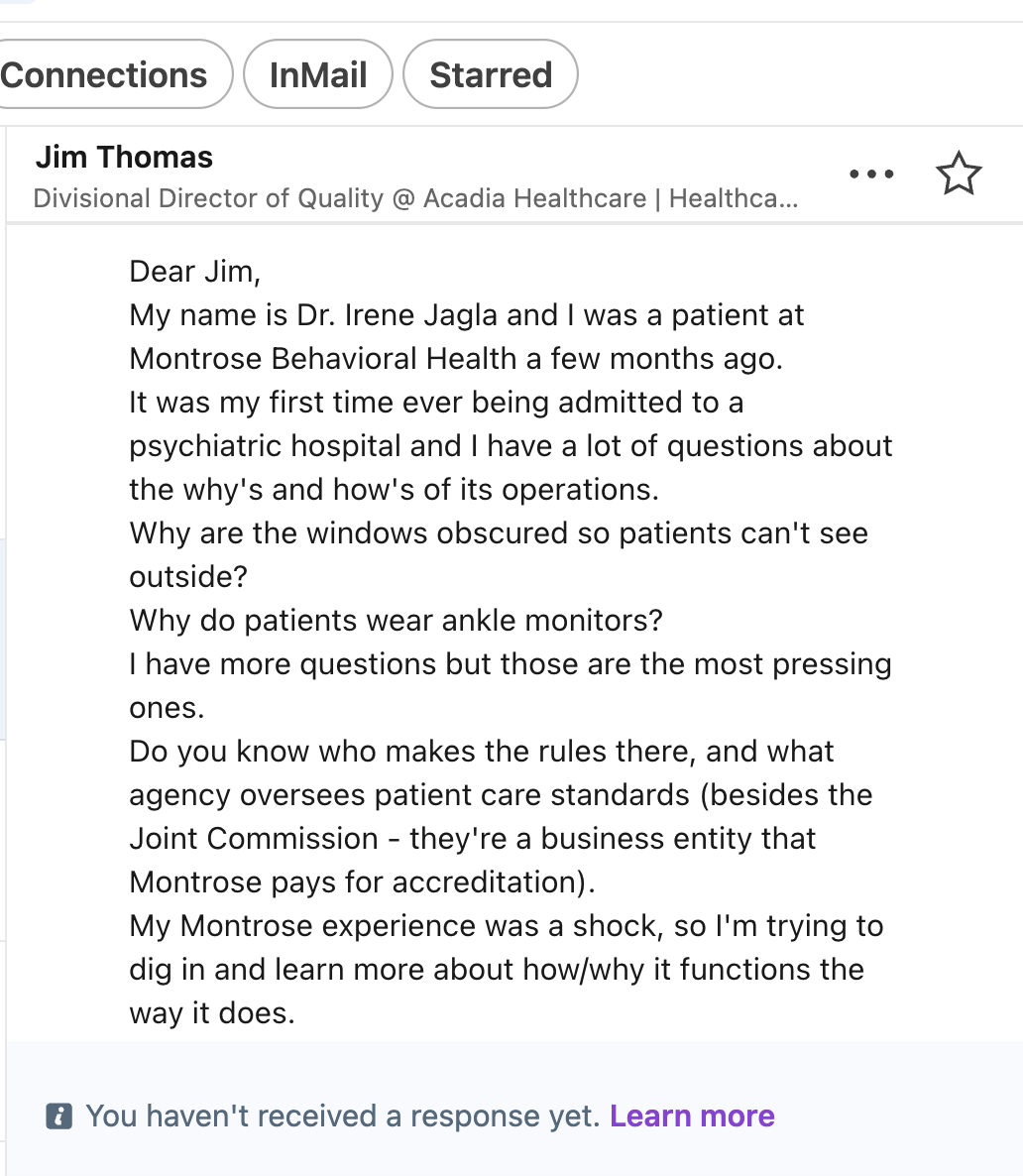
Finally, I sent a LinkedIn message to Jim Thomas, Divisional Director of Quality @ Acadia Healthcare | Healthcare Compliance NASDAQ: (ACHC) asking about the rules there; namely, why patients wear ankle monitors and can’t see out the windows. He hasn’t responded yet.
ALTERNATIVES TO FOR-PROFIT MENTAL HOSPITALS IN CHICAGO
The combination of a lack of active oversight by an expert third-party, along with the pressure to answer to shareholders and operate on thin margins makes mental hospitals like Montrose less like treatment centers and more like prisons. But there are other more humane options if you need help.
One local Chicago option is Thresholds on Ravenswood Ave., a non-profit that receives state and city funding, along with donations, to operate wraparound services, such as individual and group therapy; career counseling; addiction treatment, and more. The Living Room, an extension of Thresholds, serves those experiencing an acute mental health crisis by providing a safe, comfortable space to decompress and talk to a counselor. I visited on June 22, 2026 and talked to the receptionist there, who was both honest and excited about Thresholds services.
She explained to me that each Living Room Peer Support Specialist handles incoming visitors by having conversations with them and providing support for whatever issues they’re experiencing. Then, Specialists refer visitors to an Intake Counselor, who gets more in-depth information about the visitor, and after the Intake a visitor can become a Member of Thresholds and gain access to individual therapy, group therapy (which includes a Walking Group, art classes, and meditation and mindfulness sessions, among others), a pharmacy, and medical clinic. While Thresholds members (or initial visitors to the Living Room) do not get beds or rooms at the Ravenswood location, staff does help housing-insecure visitors and patients find available beds in the city.
Counselors work with members to create long-term goals for recovery, which is very different from the band-aid approach of places like Montrose that isolate patients temporarily from society.
During my visit to Thresholds, the receptionist said something that resonated with a revelation I had while at Montrose. When I asked her about Thresholds’ patient care philosophy, she said that it focuses on human-first communication and collaboration with visitors and members. Even if someone is diagnosed with schizophrenia, for example, Thresholds staff treat them like a person first and give them the same respect, kindness, and courtesy that any other person would get, regardless of their condition. The receptionist explained it this way: “If you have someone who has schizophrenia, and you treat them just as a schizophrenic, they’re going to notice and they’re going to feel some type of way about that. But if you just treat them with respect, like a normal person, the same way you’d treat me, you gain trust and they’re more likely to cooperate. As soon as a visitor or member notices that you’re disrespectful, condescending, or see them simply as a ‘schizophrenic’ and nothing else, any treatment or recovery plan isn’t going to resonate with them.”
FUTURE PLANS AND HOPE FOR THE FUTURE
The Chicago Department of Public Health announced in April 2026 that it’s investing over $16 million for the expansion of community-based mental health care, which will “provide mental and behavioral health clinics in non-clinical locations like schools, public transit, community centers and other public spaces” (CBS Chicago).
Organizations like Coalition to Save Our Mental Health Centers have successfully pushed referendums in the wake of a history of the city closing its mental health clinics. In 2004, the EMHSP (Expanded Mental Health Services Programs) was created to fill service gaps outside the city system after 7 of 19 city-run clinics were shut down. These shutdowns led to the Community Expanded Mental Health Services Act which allowed residents to vote for mental health care referendums to open centers in their neighborhoods. A total of three centers have already been opened, with residents voting to open six more facilities. Some of the facilities that have already been opened, like the Encompassing Center, do partner with existing privately-owned, for-profit mental hospitals, such as Hartgrove.
Finally, there are politicians who are invested in improving the mental healthcare system and are working tirelessly to ensure that more humane options are available to people in the Chicagoland area. State. Rep. Lindsey LaPointe is focusing on a three-pronged approach in which a person experiencing a mental health crisis has someone to call (that’s not 911); someone to come to them if needed (like a mobile crisis response unit, not Police); and somewhere to go that isn’t an emergency room or for-profit mental hospital.
Changing the current mental health landscape in Chicago starts with providing crisis care that doesn’t put patients at risk of interactions with police or restrictive, medical environments that can cause more harm or trauma.
Currently, most people aren’t widely familiar with places like Thresholds, and people are still less likely to call 988 (according to a Cook County Department of Public Health study that found 55% of survey respondents who had used the crisis care system said they called 911 or visited an emergency room instead of calling 988).
When more people start using 988, getting treatment earlier, and visiting places like Thresholds to address acute mental health symptoms, we can start resisting the overreach of for-profit hospitals like Montrose. The truth is, Montrose was not my only option, and it doesn’t have to be with the three-pronged approach, which includes someone to call; somewhere to go; and someone to come help.